Barbell listings are dense with numbers, and the industry has never standardised the vocabulary, so two makers can describe the same knurl in completely different words. What follows is every specification you will encounter, in the order it usually appears, with an honest note on how much it matters.
If you read only four entries, read shaft diameter, rotation system, load rating and finish. Those four decide almost every purchase.
Bar weight
20kg for a men’s bar, 15kg for a women’s, 25kg for a squat bar, 5kg to 10kg for a technique bar. Worth checking rather than assuming: a squat bar is 5kg heavier than the bar every programme assumes, and competition collars add 2.5kg each on top.
Shaft diameter
The single most informative number on the listing, because it tells you what the bar is for. 25mm women’s, 27mm deadlift, 28mm weightlifting, 28.5mm multipurpose, 29mm powerlifting, 32–35mm squat. Stiffness rises steeply with diameter, so one millimetre is a real difference.
Sleeve diameter
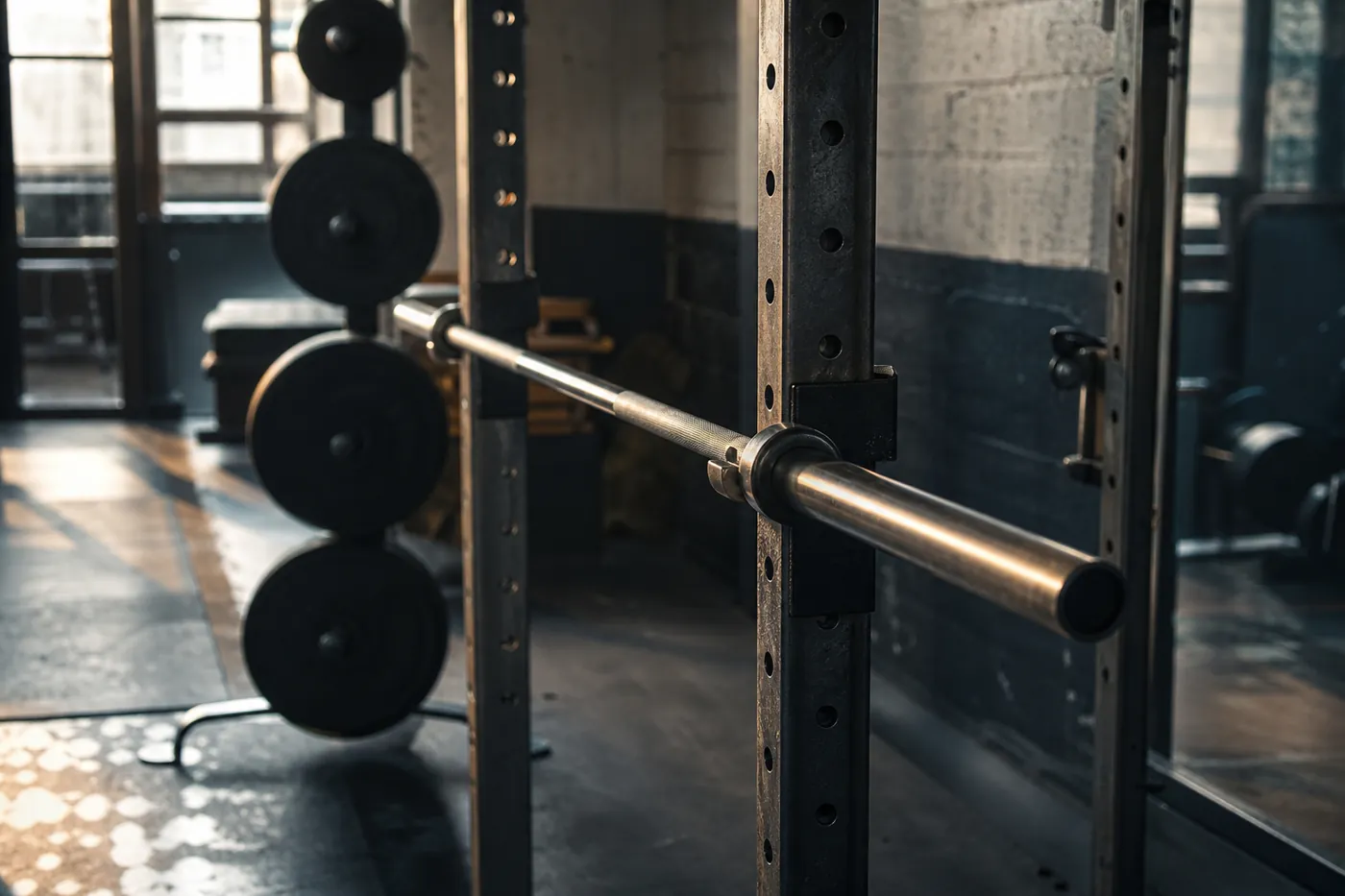
50mm on every Olympic bar. This is what the word "Olympic" means in this context. A "standard" bar has 25mm sleeves and the plates are not interchangeable in either direction.
Loadable sleeve length
How much plate will physically fit on each end, typically 400–430mm on a 7ft bar and as little as 220mm on a 6ft bar. Check it against the plates you own: 450mm bumper plates are thick for their weight and fill a sleeve far faster than thin calibrated steel.
Tensile strength
A measure of the steel, in PSI. On bars sold in Britain the useful range is roughly 180,000 to 240,000 PSI. Higher is better all else equal. It is one number among several, and a maker who publishes it alongside a load rating is being more useful than one who publishes a big PSI figure alone.
Load / drop rating
What the maker has tested the finished bar to, in kilos. Ranges hugely: 180kg on an entry-level bar, 680kg on most mid-range bars, above 907kg on a commercial weightlifting bar. A rating is a limit, not a target — leave real headroom above your best lifts.
Knurling
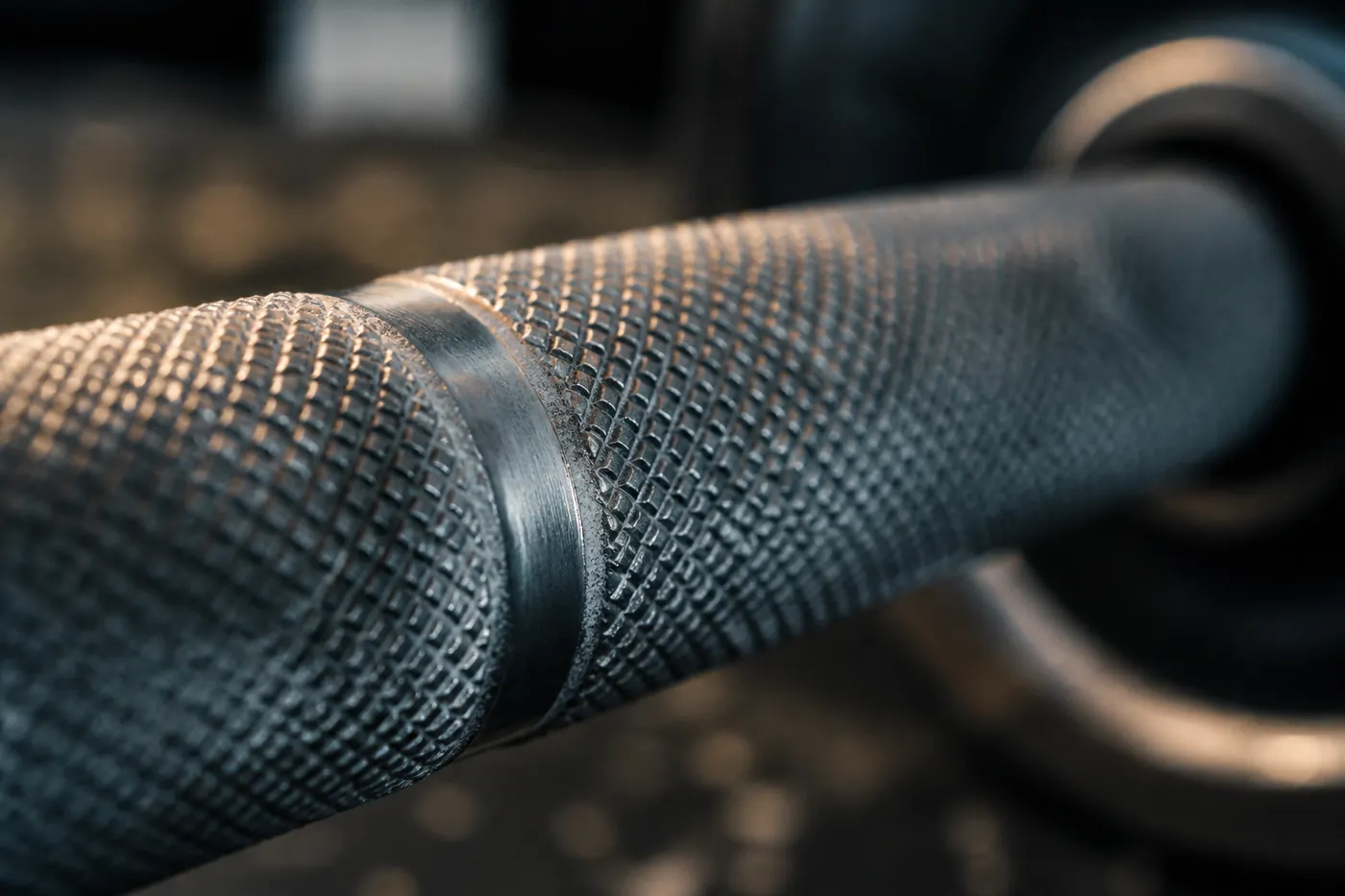
The cross-hatched grip pattern cut into the shaft. Makers describe it by depth and shape: 1.0 standard, 1.2 moderate, 1.5 aggressive; volcano, mountain, diamond, passive-aggressive. Deeper grips better and chews your hands up faster. Volcano patterns are a middle ground — flat-topped peaks that hold without biting.
Centre knurl
A patch of knurling in the middle of the shaft. It stops the bar sliding down your back under a heavy squat, and it grates on your sternum during a bench press and your throat in a front rack. Power bars nearly always have one; weightlifting and multipurpose bars often do not. A "passive" centre knurl is a deliberate halfway house.
Knurl marks
The smooth rings machined into the shaft that mark legal grip widths. Powerlifting rings sit 810mm apart; weightlifting rings sit 910mm apart. A dual-marked bar has both, which is four rings and takes a session or two to stop noticing.
Whip
How much the bar bends under load and keeps bending. Desirable on a deadlift bar, where the flex lets you pull the slack out before the plates move. A liability under a squat or a bench press, where a bar still oscillating is a bar fighting you. Makers rate it low, medium or high.
Spin / rotation system
Bronze bushings for slow, controlled rotation; needle bearings for fast, free rotation; sometimes both in one sleeve. Bearings matter enormously for the snatch and clean and jerk and are a slight drawback everywhere else. Bearing counts are published — five per sleeve, eight per bar, ten per bar — though sleeve sealing matters at least as much.
Weight tolerance
How close the bar is to its stated weight. A training bar is typically ±1%, which is 200g on a 20kg bar. A calibrated competition bar is ±50g or tighter, and Eleiko quote +20g / −10g. It matters if a record is being ratified and not at all in your garage.
Finish
Bare steel and black oxide grip best and rust if neglected. Zinc is cheap and wears. Hard chrome is durable and the default for shared gyms. Stainless never rusts and costs more. Cerakote is a baked ceramic coating that resists corrosion well and sits slightly on top of the knurl. In a damp British garage this is a functional decision, not a cosmetic one.
Straightness
Rarely published, which makes it worth noticing when it is. Bulldog Gear quote ±0.1mm on some bars. A bar machined straight and kept within its rating stays straight; a bar loaded past its rating does not, and a bent bar is scrap.
Certification
IWF for weightlifting, IPF for powerlifting, WPPO for para powerlifting. It means the federation has tested and approved that exact bar for sanctioned competition. It is expensive and buys you nothing outside competition. Read the wording carefully: "built to IWF specification" is not "IWF certified", and the honest makers say which they mean.
F Rating
Rogue’s own stiffness scale, running roughly F6-R to F10-R, where a higher number is a stiffer bar. It is a useful shorthand within Rogue’s range and not comparable to anything outside it, because no other maker uses it.