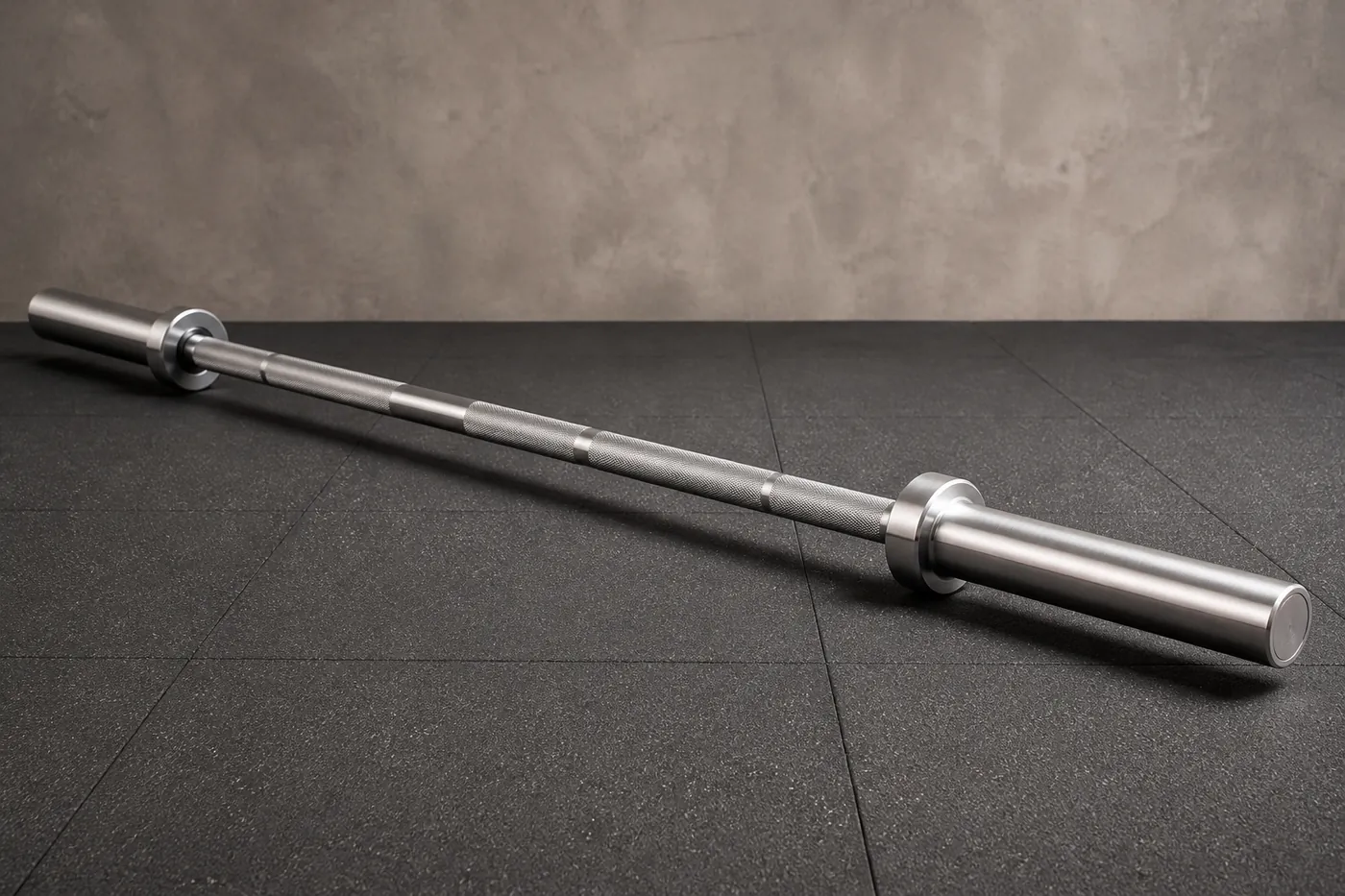
Why 29mm, and why it matters more than it sounds
Stiffness does not rise in step with diameter — it rises much faster than that. Going from 28mm to 29mm sounds trivial and is not. Under 250kg a 28mm shaft visibly bends and keeps moving after you have stopped; a 29mm shaft settles. The same logic is why squat bars go to 32mm and 35mm.
The flip side is that a stiff bar is a bad weightlifting bar. There is no whip to help you out of the bottom of a clean, and the sleeves on a power bar turn slowly on purpose, so the bar will not rotate in your hands as you turn it over.
The centre knurl, which people argue about
Almost every power bar has a patch of knurling in the middle of the shaft. It is there to stop the bar sliding down your back under a heavy squat, and it works. It also grates on your sternum during a bench press and on your throat during a front squat, which is why weightlifting bars often omit it.
If a bar is going to be your only bar and you bench a lot, a passive or absent centre knurl is worth considering. If it is a dedicated squat and deadlift bar, take the centre knurl.
Competition approval, and when you actually need it
A bar described as IPF approved has been through the federation’s approval process and is calibrated — its weight is correct to within grams rather than to within one per cent. You need that if you are competing in an IPF-affiliated meet, or if your gym hosts one.
If you are not competing, the calibration buys you nothing a training bar does not already give you. Several makers sell the same geometry in a non-calibrated version for substantially less, and say so openly on the listing. Strength Shop’s chrome Riot Power Bar is the clearest example on this site: identical dimensions and knurl to its IPF-approved sibling, explicitly sold as a training bar.